January 16, 2022

Death traps

Mornings at this time of year are dominated by harvesting fruit. From mid-December it was boysenberries – and we have the most abundant crop ever of these wonderful juicy and slightly tart long black berries. They’re still going a month on, although have slowed, thank goodness. There are only so many one can eat after all – for breakfast lunch and dinner at the moment – and the freezer is well stocked already. Friends and neighbours have also benefitted. As have the birds. The decision was made not to net the boysenberries this year. Too hard. I was sceptical but in fact this year’s crop has been so huge the few berries the birds have taken has almost been a relief!

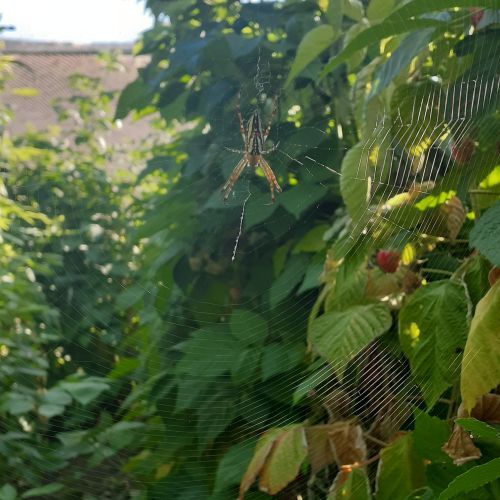
As well as boysenberries though there are now raspberries to pick. These vines are covered and it is rather a jungle in there despite our best efforts to keep them under control. The nets keep the birds out, but not the bees, other insects, or tiny tree frogs. The latter are attracted by the shady cool environment, and a regular supply of moisture. So there are small risks and to avoid them I need to navigate some fragile barriers as I make my way down the row. Three delicate, finely spun and ecliptic structures greet me every day. They’re a silent, sticky and visible klaxon strung across the path, their owner stretched out and waiting in the middle, shimmering in the dappled sunlight, a warning to the unwary. But I know they’re there so I’m prepared. I flicked a morsel to one of them once, by way of an apology for the daily destruction I cause to their handiwork. Or should that be legwork? I was stunned at the speed that tiny creature was wrapped, bound and suspended. Talk about deadly efficiency.
By now the iridescent proprietors of these deadly traps must know I’m coming. Perhaps they sigh with irritation at the knowledge they will have running repairs to do again when I’ve gone. I like to think they realise I’ve had the decency to disturb them as little as possible, by trying not to wreck the whole web. I can only admire their patience and resilience since they’ve yet to give up in disgust and abandon this real estate. It must be lucrative, because tomorrow those three webs will almost certainly be strung across the narrow walkway separating the two rows of raspberry canes.


Share this post on socials

Magni
By Anne Layton-Bennett June 14, 2026
It’s taken far too many months for this marvellous model to grace the dedicated desk space in my office. When Fiona comes to visit next she will be very surprised, and hopefully gratified, that her amazing creative talent is finally on display. We’ve known each other for a very long time, and during the insanely busy time when I was helping to run the flower farm, working part-time in a school library, doing a spot of journalism on the side, and fighting the proposed pulp mill that is the subject of the manuscript I’m hoping to get published, Fiona cleaned my house each week. There’s only so much a person can do after all, and it has to be said cleaning our house during those manic years was fairly low down on the list of my priorities. But Fiona is a woman of many talents and she certainly possesses one that I so don’t have: sewing and dressmaking. So over the years she’s also made a few garments based on the pattern of a favourite garment that I was particularly fond of, and she’s also done some clothing alterations for both of us. My skills with needles and thread are limited to sewing on buttons, and taking up hems on John’s too-long pairs of jeans. Anything else is beyond me. But this fabulous model is the pièce de résistance – along with the beautiful crocheted knee warmer she gave me last year. This was when winter was approaching and so determined was I to finish writing the book, I decided to get out of bed at the insane hour of 5am and get in a solid hour’s writing in before dog walking and the demands of the day took over. Fiona was also one of many Tasmanians who needed to be circumspect about her opinion of the pulp mill. It was a project that polarised people, including families and friendships. She was one of several who passed on snippets of useful information, but on the basis of anonymity so it couldn’t be sheeted home to her.  Needless to say Fiona will be one of those whose contribution will be acknowledged – when this book is finally accepted by a publisher.
By Anne Layton-Bennett June 8, 2026
Early lambing season a sign of changing seasons? Or economic reality?
By Anne Layton-Bennett May 18, 2026
Changing climate is affecting plants, and they are increasingly confused by a warming world. Yet despite the warnings by scientists about the risks of more frequent weather extremes, governments are still failing to act quickly enough.

Latest from my blog...