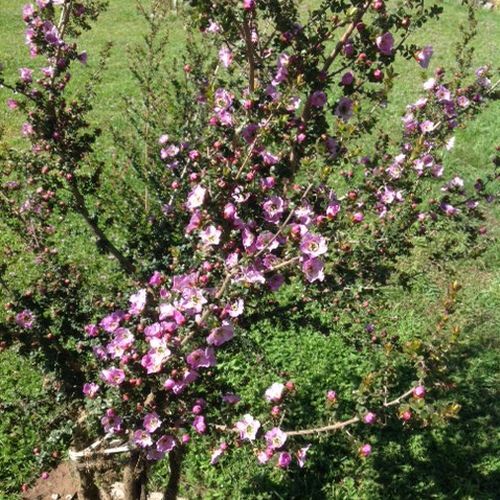
We’d not been at this property long before John began to plant out some of the native bushes and trees he’d already got started from cuttings and seeds before we left the old one. His interest in Australian natives really began when he sought advice from our horticulturist friend and colleague (another John) about establishing a windbreak to protect our hothouses from the strong winds that regularly blow up from the river at certain times of the year. There was a reason for choosing to name our former flower-growing business Seabreeze Flowers!
Twenty-odd years later the windbreak was all grown up and had expanded considerably, and it also included many more species of eucalypt, acacia, and grevilleas, correas and baeckias, etc. from all parts of Australia than it did to begin with. A few exceptions were those from the Northern Territory or far North Queensland, given their chances of survival were slim in Tasmania’s colder climate. Species from these regions were experiments, because they either looked good, had stunning foliage or flowers, or the challenge of getting them to grow just appealed, but it was interesting to realise how many species that hailed from much warmer parts, did actually grow remarkably well if sufficient care was taken to understand the soil and weather conditions they preferred that would assist their survival.
It didn’t take us long to notice that all these trees and bushes attracted many more of the smaller bird varieties to the property, songbirds, honeyeaters, and even a few, like the flame, and scarlet robins, that are now considered vulnerable or threatened species. It also didn’t take us long to notice the absence of these birds at our new place, which is surrounded by farmland rather than bushland, and where our feathered visitors tend to be magpies, butcher birds, green parrots, rosellas, and pink and grey galahs. Even sparrows are a rare sight here.
Soon though this will change. We hope. The acre of paddock that once was home to a couple of Jersey cows – the last in the herd that the property’s retired farmer owners brought with them when they moved here – is slowly but surely being taken over by native trees. Most have been grown and nurtured from seeds and cuttings collected from their parents at the old property, and tended like small children by John, until considered mature enough to make it on their own.

This nurturing means regular (if not necessarily frequent) watering in the summer, and covering them on frosty winter nights. So as we head into serious winter territory John is paying close attention to the weather. If the temperature drops and the skies are clear as the afternoon winds down to 4pm-ish he does the rounds of the still-vulnerable trees, wrapping them with hessian to protect them from the frost. And the appetites of rabbits.
In Tassie the serious frosts don’t tend to occur until after the shortest day, so this routine looks set to continue for a couple of months before he can relax. And who knows, by the time spring rolls around again some of these native trees may have grown large enough for a few of our smaller birds to finally consider them suitable habitat to make a home.
Share this post on socials